
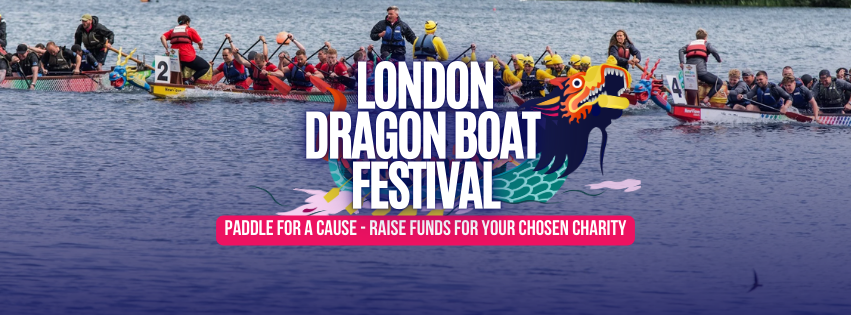
London dragon boat festival 2026
WHEN
Thursday 10th september 2026
WHERE
Surrey Docks Fitness & Water Sports Centre, Rope Street, London, SE16 7SX
Join The Community
Check out the London Dragon Boat Festival Facebook page! Follow the latest news about the event, including updates on teams entered!
Please read all the information below as it has lots of important detail included about the event, what it involves, what to expect and important safety information for you and your team.
We can’t wait to see you all on Thursday 10th September 2026!
Got questions? email: dragonboatevents@newwave-events.co.uk or call 01536 674 748
HELPFUL REMINDERS & DEADLINES
Important Deadlines
Team Names – Please confirm your team name by latest Thursday 27th August 2026 on the entry portal. Teams that fail to confirm it by this date will be given their company name as their team name.
BBQ Choices – Please make your BBQ choices and submit them on the entry portal by latest Thursday 13th August 2026.
Boat Logos – If you are a platinum entry you have a boat logo included in your entry. Please ensure this is uploaded to the entry portal by latest Thursday 13th August 2026.
Souvenir Programme Adverts – If you are a platinum entry you have a half page advert included in your entry. Please ensure these are submitted on the entry portal by latest Thursday 13th August 2026.
Sizes width x height
Full page 148.5 x 210mm
Half page 148.5 x 105mm
Quarter page 74.25 x 105mm
For inside covers add 20% and back cover add 25%
File formats
Ideally we require a high resolution print-ready PDF file with crop marks and 3mm of bleed
Image resolution should be 300dpi for photos or drawings with scaling no more than 120%
Fonts should be embedded into the pdf or set to outline in your application
Safe area – any text or important items should be 3-5mm inside the edge of your document
Helpful Reminders
- Dress appropriately in comfortable clothes and bring protection for all weather types e.g. raincoat, sun cream, sunglasses, hat etc.
- We recommend participants bring their own drinking water on-site.
- Bring all required paperwork with you on the day, provided in this pack.
- Limited lockers are available at the venue – please bring £1 for a token which will be refunded upon return
- There is NO team parking available – please use other modes of transport.
- Teams are not permitted to bring their own alcohol on site.
CREW LIST & ACKNOWLEDGMENT OF RISK FORMS
Updated team lists will be added here once entries come in.
Risk Forms
All teams must hand in a completed Acknowledgment of Risk Form prior to racing on the day of the event. This must be completed in full with all participants names and signatures. Please do not email this to us beforehand, bring it with you on the day.
There is also a ‘Crew Info’ sheet below that is optional to fill in for commentary purposes on the day.
TEAM MEDIA PACK
RACE SCHEDULE & ON THE DAY
Race Schedule
The Race Schedule will be available from W/C 31st August 2026
COMPETITION FORMAT & EVENT ORGANISERS
Competition Format
- The London Dragon Boat Festival is open to all. Previous experience of Dragon Boat Racing is not necessary to enter a crew but all crew members must be water confident whilst wearing a buoyancy aid in cold water. Competitors under 18 years must supply parental consent in writing to the Race Organisers and all competitors must be over 16 years old. All competitors must wear a buoyancy aid (provided by the event organisers) and be entered on the Crew List they are racing for, to validate their public liability insurance cover.
- Equipment – All boats, necessary equipment for racing and buoyancy vests are supplied. Only paddles provided by the organisers are permitted.
- Race Results – All race results, apart from the semi-finals and final, will be based on times. Each crew will receive two races, weather permitting, and their fastest time will count. The twelve crews with the fastest times go through to the semi-finals. From the three semi-finals the winning crews and the fastest loser will proceed to the Grand Final.
- Boats & Race Course – Each crew will get the opportunity to race in a different boat and racing lane in each heat to ensure complete fairness. The race distance will be approximately 180m.
- Prizes – The London Dragon Boat Festival trophy will be awarded to the overall winning crew and medals will be presented to the top three crews and the best placed mixed crew. Trophies will also be awarded to the second, third and fourth placed crews plus the top mixed crew (minimum 5 ladies paddling) and to the crew presenting evidence on the day of raising the most money for their chosen charity.
Event and Race Organisers
- NewWave Events are the Event Organisers for the day and all questions relating to the dragon boat racing programme and organization of the event should be directed to them.
- Boat Helms (Steerers) – All crews will be allocated a Helm for each race by the Chief Boat Marshall. The Helm will automatically become the Boat Captain once the crew is ready for loading and all crew members should take instruction from the Helm and NOT their own Crew Manager whilst racing.
- Qualifications – All Steerers/Helms and Race Officials are provided by the Race Organisers and are fully qualified using the BDA standards as a minimum qualification for this type of event.
RACING RULES AND REGULATIONS & RACE ADMIN
Racing Rules & Regulations
- Crews – Up to 15 competitors may be shown on the Crew List. However when racing, Crews are not to exceed 11 persons, including the drummer. Crews may race with less than 11 but the number in the boat must be the same at the finish of the race as at the start. You can reduce the number of paddlers to a minimum of 8 but you must always have a drummer.
- Crew Manager – Every crew must nominate a Crew Manager on their crew list. The Crew Manager has overall responsibility for the conduct and actions of the crew both on and off the water. The Chief Official and other Race Officials will only communicate on ‘official matters’ with the Crew Manager.
- Crew Composition – Crews may be mixed, all female or all male.
- The Drummer – The Drummer must sit on the seat provided and actively beat the drum throughout the race.
- Embarking – Crews must report to the Boat Marshalling Area when called forward by the Chief Boat Marshall or over the PA. This will normally be 20 minutes before a race start time. Crews failing to report on time may be barred from the competition. It is paramount to the smooth running of the event that crews report to the Boat Marshalling Area in plenty of time. Crews Managers assistance with this is greatly appreciated.
- Starts – Crews must be in their correct Dragon Boats and be in the start area, at least 5 minutes before their start time. All races will be started without reference to absentees.
- Starting Position – The position of the dragon boats on the Start line shall be that the foremost part of each boat (including the head) is on the Start Line and that all the boats are aligned.
- Starting Signal – When the Starter is satisfied that all the boats are correctly aligned, the Starter shall alert the crews by saying ‘Crews are you ready’. IF THE CREW IS NOT READY, the Helm is to indicate this situation by raising a hand clearly above head height and keeping it there, until the Starter acknowledges the situation.
- Start – When the starter is satisfied that all crews ‘are ready’ the starter shall give the starting signal by shouting ‘Attention’ followed by the word ‘Go’. The time between Attention and Go, shall not exceed 5 seconds. A Helm who raises a hand after the word Attention and before Go, will be ignored if, in the opinion of the Starter, the boats are correctly aligned.
- False Starts – If a crew starts after the word Attention but before Go, it has made a False Start. The Starter shall determine if a False Start has been made and will immediately recall the crews by shouting STOP, STOP, STOP.
- Re-Call – Once all crews have returned to the Start Line, the Starter will identify the crew or crews responsible for the False Start and warn them of their offence. If the same crew causes two False starts the Starter shall exclude them from the race. Any crew that fails to return to the Start Line immediately after a False Start, may be excluded from the race, or get a time penalty, of up to five seconds, which will be added to their race time.
- Finishes – After finishing a race, each participating crew must return immediately to the Embarking area by paddling outside the Racing Course. This task must be completed within a maximum of 3 minutes from the finish of the race.
- Disembarking – After disembarking from the boat the crew is responsible for immediately returning the paddles and buoyancy aids used to the correct boat marshalling area or storage bins if supplied.
- Race Conduct – Crews must paddle in a straight line and keep within their allotted lane from the start to the finish of their race. It is forbidden to knowingly impede other boats. Steerers must order their paddlers to ‘stop paddling’ if a collision is imminent. CREWS THAT DO NOT STOP PADDLING AND, BY SO DOING CAUSE A COLLISION, MAY BE DISQUALIFIED FROM THE COMPETITION.
- Collisions and Capsizes – Any crew that causes a boat to collide with another one or that damages the boat or paddles, or that deliberately swamps or causes a boat to capsize including their own, risks disqualification from the competition.
- Officials – All Race Officials are responsible to the Chief Official for the conduct of the races and for ensuring that the Challenge Rules & Regulations are fully complied with. Crews must follow directions of the Race Officials at all times. The Chief Official’s decision is final and will be made in accordance with the Challenge Rules & Regulations.
Race Administration
- Crew Lists – A combined Crew List & Acknowledgment of Risk form certifying that all crew members are water confident and listing the crew members by name must be completed by each crew and handed to the Race Organiser before the crew competes in its first race. Only those named on the crew list will be allowed to compete. However, additions can be added throughout the day. Failure to complete the Crew List correctly and in full may invalidate the insurance cover provided for crews.
- Crew Managers Meeting – A Crew Managers meeting will be held at 12:30 and it is imperative that ALL CREWS are represented, irrespective of their first race time as this is a Safety Briefing and also any alterations to the race programme will be announced at this time. Crews are not permitted to arrive on site until after 11:30.
VENUE FACITILIES & PARKING
Venue Facilities
There are 2 changing rooms (male and female) which we will have exclusive use of.
Each changing room has approximately 55 lockers in which can be accessed on a first come, first serve basis. You will need to bring your own lock for the lockers.
There is NO parking available at the venue, so please arrange alternative transport for your team.
How to get there
The post code is SE16 7SX.
Tube/train is the easiest public transport option and the nearest stations within walking distance are Canada Water (Jubilee Line) and Surrey Quays (London Overground).
Limited bike racks are also available.
FUNDRAISING AND EVENT SUPPORTERS
We created this open charity model by identifying a gap in the market for small and medium sized companies like yours. Many want to enter a high impact event but have a specific, chosen charity they are passionate about supporting. This event is the effective, cost efficient solution. It provides a premier team building and networking day on the water, while letting you fundraise directly for your cause—all within a single, affordable entry.
How to Start Fundraising –
- Choose Your Cause: Select your charity and simply let us know who you’re supporting when you register. There’s no limit to the passion you can bring.
Create Your Hub: Set up a dedicated online fundraising page on platforms like JustGiving, GoFundMe, or your charity’s own portal. This is your central mission control for donations.
Shout About It: Announce your team’s mission! Email colleagues, post on social media, and get your corporate partners involved. Every share turns into potential support.
ENTERTAINMENT & CATERING
Of course, the spectacular racing which will take place every 15 minutes between 2pm and 5pm approx as well as additional entertainment
Catering and Refreshments
BBQ
A BBQ will be served from approx. 3:30pm, the cost of which is included within your entry fee for up to 11 crew members. If you would like to order further meals for additional crew members, guests or spectators please ensure these have been ordered on the entry portal no later than 4th September 2026. Please note, your BBQ tickets will be given to your crew manager at registration on the day.
Cash Bar
A cash bar will be available between the hours of 2pm and 7pm. Any teams/companies wishing to set up a company account, please contact Eamon Phillips of Barstop, on 07977 090910 or eamonphillips@barstop.co.uk prior to the day to make the necessary arrangements.
EVENT PHOTOGRAPHY
Team Photographs

Professional event photographer, Magdalena Sienicka, will be taking photos of crews and the day’s action and all photos will be available free of charge via a google drive link that will be emailed to crew managers after the event. Please tag NewWave Events when posting on social media.
Please note, participants and spectators must acknowledge the fact this event is in the public arena and therefore by entering the venue, this may result in the recording of their image.
BDA GUIDE & SAFETY ON WATER
Safety on the Water
- Fit To Race – The safety of a Dragon Boat Crew on the water is of prime concern to everyone associated with the event, not least the crew itself, who have a responsibility to conduct themselves properly, in both a competitive and social sense. Crew Managers are to ensure that their crews are fully briefed on the contents of the BDA ‘Safety on the Water’ guide, a copy of which is enclosed in this Crew Managers Pack.
- Crew Checking – All crews will be checked by the Chief Boat Marshall, before they embark, to ensure that they are ‘Fit to Race’. If a crew or competitor is deemed not to be ‘Fit to Race’, they will not be allowed to race and may be disqualified for the remainder of the competition.
- Alcohol – Alcohol and water sports DO NOT MIX. It is the Crew Managers responsibility to ensure that all their crew members are advised that any crew or competitor deemed to be unfit to Race due to alcohol and or drugs will be disqualified from the competition. This is for your own safety.
- Water Safety Cover – There will be a minimum of two safety boats on the water at all times. All safety boats are manned by fully qualified rescue boat staff.
- First Aid Cover – A professional Emergency Medical Technician (EMT) with full response kit will be on site at all times during the event. Also, most of the event staff are trained to deal with minor first aid incidents.
- Dress – It is recommended that all competitors wear shorts, T-shirt and old trainers for racing and bring with them a wind/waterproof jacket. Footwear that is secured to the foot must be worn whilst racing e.g. trainers, sandals etc. i.e. no flip flops etc. Crew members are NOT allowed to wear boots in the boats and jeans are not recommended. It is also advisable that everyone brings a towel and change of clothes, as competitors can expect to get damp from the splashes made during racing.
British Dragon Boat Racing Association
Guide to Safety on the Water
This guide is primarily for those organising or competing in the sport of Dragon Boat Racing. It covers their responsibilities when participating in a dragon boat event and should therefore be used as a general guide to ‘Safety on the Water’ in a competitive situation.
The Conditions
Because of the size and design of the Dragon Boat, and the water conditions in which racing takes place, that is placid water, dragon boating is inherently safe and a capsize especially in such conditions, unless the crew is at fault, is a rarity.
However, in any water sport, because of the environment itself, there is always an element of danger. Add to this the folly and impatience of human nature and the ingredients for an accident may eventually come together to the detriment of the sport as a whole. Dragon Boat Racing is no exception to the rule and it is the duty of all who practise the sport – competitors, race organisers, coaches and officials alike – to be aware of the potential dangers inherent in the sport; to be safety conscious – not safety extreme – and to ensure that dragon boating is conducted in a responsible manner.
In adverse weather conditions and when there are strong winds, Dragon Boats can be swamped with water and have been known to capsize, especially when turning sideways on to the prevailing wind or wave pattern. The inexperience of the crew in such circumstances can be a major factor in a boat capsizing.
In all water conditions, good or bad, the key to safety is the application of good old COMMON SENSE by all those taking part in the activity. Playing around in a Dragon Boat and deliberately capsizing it, even in warm and sunny conditions, can be dangerous to both the crew and other water users alike. In certain circumstances it could be lethal; a Dragon Boat moving at speed through the water cannot easily be stopped and another crew in the water from a capsized boat cannot easily be seen! Crews that deliberately cause their boat or another boat to capsize when racing, or who ram another boat during the event, will be disqualified from the event.
Who is Responsible
Dragon Boat Racing is a ‘team sport’, each boat can carry a crew of up to 11 persons. It is not unusual for over 72 competitors to be on the water, in one race. The safety of this number of competitors at any one time, is the concern of many people but primarily the Event Organiser and the Chief Official. However, ‘Safety on the Water’ is also the concern of every
Crew Member.
The Responsibilities
The broad areas of responsibility for safety are:-
The Event Organiser – It is the Event Organiser’s responsibility to ensure that adequate rescue boats, rescue personnel and Personal Flotation Aids (PFAs) are obtained for the event; that First Aid cover is provided off the water; that changing facilities and toilets are provided and that all temporary structures comply with health and safety regulations. The Event Organiser shall ensure that Crews are sent basic information on all safety matters appertaining to the competition.
The Chief Official – It is the Chief Official’s responsibility to ensure that during the racing, all rescue boats are in place and briefed; that in all conditions competitors wear PFAs and that all weak swimmers make themselves known to their helm before they get in the boat; and that all the safety procedures laid down by the Organisers are complied with.
The Crew Manager – It is the Crew Manager’s responsibility to ensure that all the crew members are water confident; that any weak swimmers are noted on their Crew List; that the combined Crew List and Acknowledgment of Risk Form is completed and lodged with Race Control; that the crew is briefed on the Racing Rules and ‘Safety on the Water’ and that at all times they are ‘fit to race’. This means that it is the Crew Manager’s responsibility to ensure that ‘socialising’ does not adversely affect the safety and performance of the crew on the water.
The Crew Members – It is the responsibility of the individual crew members to ensure that when they are on the water that they are adequately dressed for the weather conditions on the day and comply with all instructions given to them. Dragon Boating is a social sport too, so the safety of the whole crew must not be jeopardised through the consumption of alcohol or drugs; or thoughtlessness or horseplay by individual crew members.
The Helm (Boat Steerer) – The Helm is the Boat Captain. It is the Helm’s responsibility to make the final check to ensure that that the boat is water worthy and in racing condition. The Helm shall ensure that all crew members are correctly briefed on boat handling and capsize drills and that they are suitably dressed for the weather conditions and not wearing anything that may impede their ability to exit the boat or swim, in the event of a capsize or boat swamping. When on the water the Helm shall ensure that collisions with other craft are avoided. In the event of a Crew capsizing, the Helm shall ensure that the capsize drills are correctly carried out and that all crew members are accounted for and rescued.
The Safety Officer – It is the Event Safety Officer’s responsibility to ensure that all Officials and Crew Managers are aware of, and briefed regarding ‘Safety on the Water’ and any notifiable diseases, for example Weil’s disease. The Safety Officer is responsible for ensuring that the Chief Boat Marshall is made aware of any known weak swimmers or competitors with medical conditions that may affect their ability to race. The Safety Officer is responsible for producing a safety plan for the competition, to include a water circulation system for crews going to the start or ‘warming up’.
The Chief Boat Marshall – The Chief Boat Marshall shall determine if a crew is ‘fit to race’ or not and will keep a record of the number of people embarked in each boat, in each race. The Chief Boat Marshall shall ensure that all boats and equipment are in good racing condition before the first race and that they remain in good racing condition throughout the competition.
The Detail
Swimming – The Standard Required – Ideally, all members in a dragon boat crew should be able to swim at least 50 metres, but as a minimum, they must be water confident in cold and moving water and when dressed in light clothing, that is, racing dress (shorts and vest) plus waterproof top and trousers and light footwear (trainers or similar footwear) and wearing a PFA.
Personal Floatation Aids (PFAs) – When to wear them – Personal Floatation Aid (PFA), such as a Buoyancy Aid MUST be worn by all competitors whilst in a dragon boat and in the boat marshalling area and/or on the pontoons. The Race Organisers will supply these.
Safety on Embarkation
Boat Balance – Before leaving the embarking area, the Helm should ensure that the boat is well balanced. That is, that each pair of racers are of similar weight or height and that, generally, the heavier pairs are seated in the boat’s middle section. The Helm must know the number of people in the boat.
The Buddy System – The crew should be ‘numbered off’ from the front of the boat and made aware that they are each responsible for the person they are paired with (across the boat) and that in the event of a capsize or the boat being swamped and sinking, their first responsibility is to themselves then to ensure that their partner is safe and well.
This is called the ‘buddy system’ and it gives each person in the boat a specific responsibility for another. The ‘Stroke Pair’ (first pair – No.2 left and 3 right) in the boat are responsible for the Drummer (1) and the ‘rear pair’ (last pair) for the Helm.
Steadying the Boat – A boat will feel ‘tippy’ especially if the crew is out of balance or moving about in an uncoordinated manner. To steady the boat in such circumstances (and when sideways on to the wind or wave pattern) the crew should be instructed by the Helm to slightly lean out over the side of the boat and place their paddle blades flat on the water, at arm’s length.
With all of the paddles on the water in this manner the boat is effectively stabilised. This is called a paddle brace and the Helm’s command should be ‘Brace the Boat’.
Stopping the Boat – When manoeuvring, turning or racing the boat it may be necessary to stop the boat suddenly, to avoid a collision with another boat or object. It is important that the crew reacts quickly but safely. An unbalanced crew over-reacting can capsize their own boat! The quickest way to stop a boat is for the crew to do a reverse paddle stroke, that is, everyone takes a backwards stroke with their paddle instead of a forward stroke.
The initial command should be ‘Stop Paddling’ followed immediately by ‘Brace the Boat’ if the boat is unstable and there is no immediate danger of a collision. If there is a danger of a collision the command ‘Stop the Boat’ should be given and the Crew instructed by the Helm to paddle backwards.
In a race situation when a collision is imminent, the Helm must immediately tell the crew to ‘Stop the Boat’. Failure by the Crew to stop the boat in such circumstances will result in disqualification.
Rescue Boats
The number of rescue boats that an Event Organiser provides will vary according to the number of boats in each race and conditions on the day. The chances of more than one boat capsizing in a race are extremely low and therefore, unless the weather conditions are extreme, it should not be necessary to have more than two safety boats in total at any one event.
Each boat should ideally be able to hold at least eight (8) passengers and should not carry more than two crew members, that is, the driver and an assistant to help with any rescues.
At least one rescue boat should be on the water for each race. The rescue boats should have a low freeboard and hand ropes on it, to allow a person to enter the boat from the water unaided. A throw line, kept on the boat, is also advised.
Capsized Dragon Boat
What to Do – In the event of a Dragon Boat capsizing each pair of paddlers should account for their buddies. The Helm should immediately ensure that all the crew are accounted for by calling out their numbers and noting the response. The crew must initially stay with the boat and leave it in the capsized position. When a boat has over-turned never swim underneath it, but in such circumstances it can be used as a floating platform, provided the crew space themselves evenly around the boat. Alternatively, under the instructions of the Boat Captain the boat may be rolled back to the upright position and used to support the crew. In all situations the Helm should remain in control of the crew and, in a race situation, await the arrival of the rescue boats. The crew should, if their paddles are within easy reach, attempt to retrieve them.
On the arrival of the rescue boats, the crew should move as directed by the operators of the boats, with the Boat Helm remaining in the water until all members of the crew have been rescued.
Recovery of Craft – As soon as the boat is alongside the water’s edge, the crew must again be accounted for on the land and any injuries dealt with immediately. If upturned, the boat may then be turned the right way up (in the water) and bailing out commenced. The boat should not be lifted out of the water unless there is only a small amount of water left in it, as this puts a considerable strain on the hull of the boat. Once the boat is almost empty of water it may be lifted on to the bank and checked for damage and all the boat’s equipment accounted for.
IN CONCLUSION: Safety is the concern of every crew member and is largely a matter of common sense. The overall responsibility for the crew off the water is the Crew Manager’s and on the water is the Boat Helm’s.
It is every competitor and official’s responsibility to ensure that Dragon Boat Racing is conducted as SAFELY AS POSSIBLE – DO IT!
BDA ‘warning’ information leaflet
Leptospirosis and Weil’s disease
It is stressed that LeptoSpirosis and Weil’s disease are both rare but can be caught by anyone engaged in a water sport. The information in this leaflet is published on the basis that ‘forewarned is forearmed’. ENJOY YOUR RACE BUT – BEWARE OF LEPTO SPIROSIS and WEIL’S DISEASE.
What is It?
LeptoSpirosis is an animal infection. After recovery the animal excretes the organisms in its urine. The bacteria survive for days or even weeks in moist conditions but only for a few hours in salt water. The infection is caught by direct contact with urine or a polluted environment. Bacteria enter through skin abrasions or via the eyes, nose or mouth.
The Illness
The usual incubation period is 2 to 12 days. Usually a ‘flu’ like illness occurs which resolves itself in 2 to 3 weeks. There may be fever, severe headache, pains in the back and calf and prostration. A few cases develop jaundice when the condition is known as Weil’s Disease. Although death may occur in about 15% of the jaundiced patients, death without jaundice is virtually unknown. Antibiotics during the first few days help in limiting the infection. Many people recover without specific treatment.
What to Do
If you think that you may have the infection go to your doctor and say that you participate in water sports and think that there may be risk of LeptoSpirosis. The doctor’s diagnosis is by clinical suspicion. Blood tests can rarely confirm the illness in time to effect treatment. They may, however, subsequently confirm it.
The microbiologist at the local hospital is the best source of advice.
Prevention
- Cover all cuts and abrasions with waterproof plasters.
- Always wear footwear to avoid cutting your feet.
- Avoid capsize drills or swimming in suspect water.
- Where at all possible, shower soon after Dragon Boating.
- If in doubt, contact your doctor early.
The Level of Risk
On average each year, 9 water sports people contract LeptoSpirosis. The instances of infection are therefore very rare and its deterioration into Weil’s disease even rarer. Weil’s disease is, however, a very serious illness which must be diagnosed and treated swiftly.
REDUCE YOUR RISK BY BEING AWARE!